Transforming Family Planning Access in Kenya: The Market Test Project Impact
Between 2021 and 2026, inSupply Health, led the Market Test and Optimizing Pharmacy Projects (OPC) to revolutionize how women access family planning (FP) and primary healthcare (PHC) products in Kenya.
The Challenge
Despite Kenya’s progress, a 14% unmet need for family planning persists, alongside a maternal mortality rate of 379 per 100,000 live births. While 70% of Kenyans prefer retail pharmacies as their first primary healthcare choice, the nation’s 8,000+ registered pharmacies have historically remained insufficiently integrated into formal Primary Care Networks.
Our Approach
We developed and tested a scalable pharmacy business model to offer convenient, discrete counseling and contraceptive products, with a heavy focus on the self-injection of DMPA-SC. The intervention was built on three core pillars:
- Trust & Awareness: Rebranding retail pharmacies as trusted health hubs using the “Jipende Jipange” consumer campaign.
- “Most people are shocked when they see the posters. They ask why we are doing that in a chemist… it is creating significant awareness.” — Pharmacy KII
- “…having posters out there has attracted not only the young generation, but also middle-aged clients… it has increased clients and other pharmacies have tried to copy.” — Pharmacy KII
- “Yes, I do trust her because once you visit, discuss your problems, and are attended to, there is no need of visiting a hospital… I can spread the news to others.” — Client Exit Interview
- “The problem people have is the myths and misconceptions out here… We formed support structures to provide credible information.” — Pharmacy KII
- Confidential Care: Training providers in advanced FP and establishing dedicated “safe spaces” inside pharmacies for private client counseling.
- “Before we started, it was very open… but now I learned about privacy and enclosed it a little bit.” — Pharmacy KII
- “In the safe space, clients can be so open because of the privacy and having no interference.” — Pharmacy KII
- “Here you are explained to very well, unlike hospital queues where they ask you, tell you to pay, and inject you without explaining side effects.” — Client Exit Interview
- “I am comfortable because I am able to guide clients through their issues. The counseling service is very beneficial both to the client and to us.” — Pharmacy KII
- Client Retention: Shifting from ad-hoc sales to longitudinal care via SMS appointment reminders and regulatory compliance tracking.
- “At the pharmacy, they will still remind you when your date is due, that you should come for the injection. That’s why since I came to this pharmacy I’ve never changed.” — Client Exit Interview
- “We have created a WhatsApp support group where we discuss family planning issues, answer concerns, and give true health content daily.” — Pharmacy KII
- “She understands my needs even when I am broke… She gives me the medicines and I pay once I get the money.” — Client Exit Interview
- “If you get clients in a busy time, most will reschedule or wait in our relaxed area reading FP manuals so they get the time needed.” — Pharmacy KII
Key Impact & Reach (2022–2026)
- 390,474 Clients Reached: Cumulatively served nearly 400,000 FP clients across the implementation and scale-up phases.
- 650 Providers Trained: Successfully trained providers across 12 counties, representing 6% of all registered pharmacies nationally.
- 490 Accreditations: Officially accredited 75% of our trained providers to deliver high-quality, safe services.
- Expanded Method Choice: Successfully broadened the pharmacy product mix beyond pills and condoms, with injectables (DMPA-IM and DMPA-SC) now making up 12.5% of total methods taken up.
- 79% Cost Reduction: Slashed provider training costs from KES 120,000 down to KES 25,000 per trainee by transitioning from a 5-day in-person model to a 4-week self-paced hybrid curriculum.
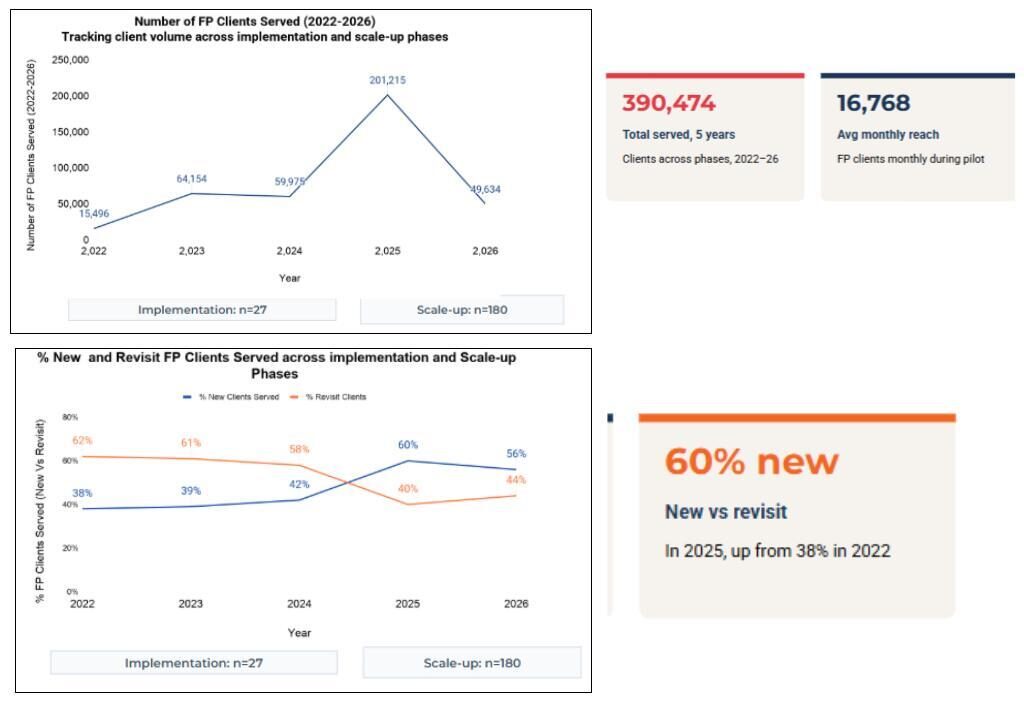
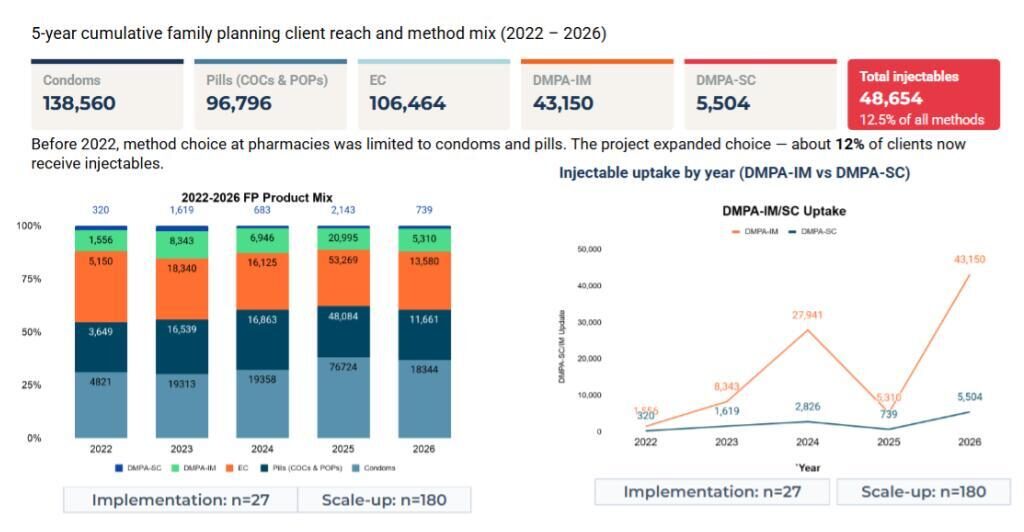
Figure 2: FP Method Mix 2022- 2026
System-Level Transformation
Beyond direct service delivery, the Market Test Project actively shaped Kenya’s health ecosystem. The project directly contributed to the revision of the National FP guidelines for 2025, developed a standardized community FP referral tool, and established formal accreditation structures for trained pharmacy providers.
The Future of Pharmacies
The future pharmacy is accessible, trusted, and digitally connected. As we move forward, we are digitizing reporting tools for seamless integration into the national health information system (KHIS) and exploring opportunities to layer additional essential services like Malaria, HIV, and TB care onto this proven model.
Call to Action: Unlocking the Future Pharmay in PHC
To fully transition retail pharmacies from standalone dispensing points into integrated, quality-assured primary healthcare (PHC) hubs, key stakeholders across the health ecosystem must commit to targeted, collective action:
- Ministry of Health (MOH): Formally update national family planning and PHC guidelines to embed accredited private pharmacies into formal Primary Care Networks (PCNs), institutionalize interoperable digital reporting tools (such as InPharmaConnect) with KHIS, and establish task-sharing frameworks for expanded reproductive health services.
- County Health Management Teams (CHMTs): Strengthen routine supportive supervision, offer HRIO-led mentorship and credentialing, facilitate bi-directional referral links between community pharmacies and public health facilities, and integrate pharmacy data into county health reviews.
- Regulatory Bodies & Professional Associations (PPB, PSK, KPA): Standardize competency-based hybrid training, grant Continuing Professional Development (CPD) points for accredited FP/PHC training, enforce safe space and quality compliance standards, and maintain transparent provider registers (e.g., via Practice 360).
- Donors & Development Partners: Provide catalytic, sustainable funding to scale blended training models, support digital integration innovations, drive market-shaping initiatives, and back rigorous implementation research for expanded pharmacy care.
- Private Sector Manufacturers & Distributors: Ensure reliable, affordable commodity stock availability (including DMPA-SC/Sayana Press), partner on demand-generation campaigns, and co-invest in sustainable commercial models for last-mile retail distribution.