
In Africa’s health systems, discussions on supply chain management often focus on infrastructure upgrades, digital tools, and procurement processes. While crucial, these elements don’t tell the full story. The true engine of a resilient supply chain lies in its workforce–their technical, analytical, and leadership skills–to make data-driven decisions and ultimately determine whether improvements succeed or fail.
Over the past year, facilitating regional supply chain training, we have observed first-hand the power of diverse perspectives. Participants ranged from aspiring professionals to seasoned specialists, creating a dynamic environment where knowledge flowed freely in all directions, not just from facilitators to learners.
Successful Strategies
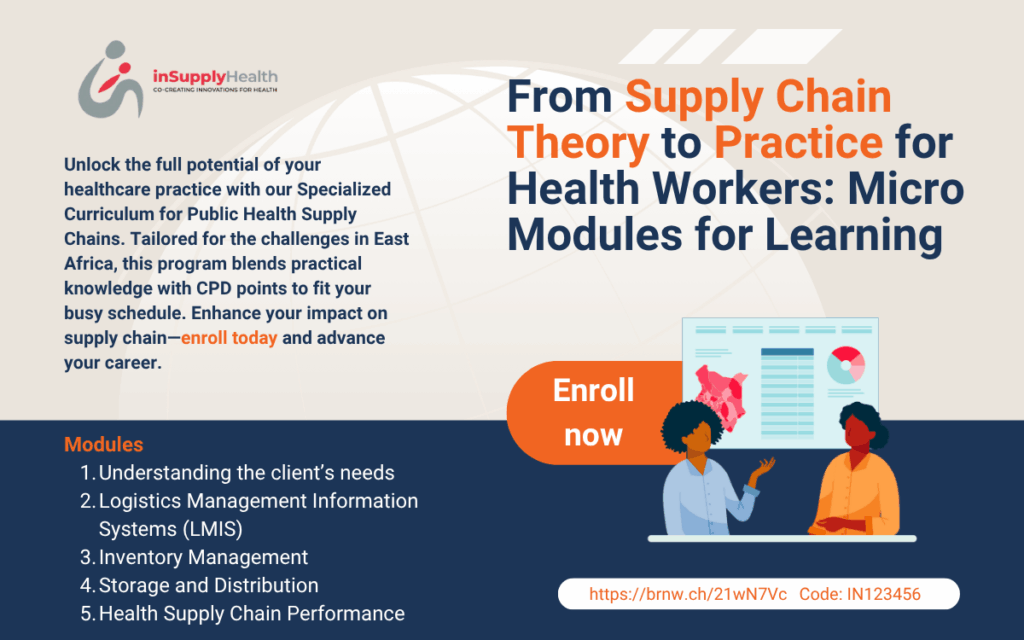
The program’s learning pathways largely stems from its learning design. The training enlisted facilitators from various organizations, each bringing unique expertise in specific areas of the health supply chain. Sessions were meticulously structured, with a lead facilitator managing both content delivery and the technical aspects of the virtual platform. This allowed us to integrate interactive tools, such as breakout rooms and Mentimeter quizzes, ensuring sustained engagement.
A key highlight was the participants’ ability to synthesise and apply the health supply chain principles to real-world scenarios. Many explored supplementary resources, such as national policies, quantification reports and LMIS dashboards, enriching group discussions with practical insights. The use of local, contextualized examples–such as last-mile distribution challenges, vaccine cold chain management and the effects of a poor supply plan–grounded abstract concepts, making them relevant to participants’ daily challenges.
Scheduling the initial cohort on weekends proved highly effective, accommodating the demanding schedules of health professionals. The accessible Learning Management System (LMS) and timely release of Zoom links and materials minimized barriers, fostering consistent participation. This engagement also yielded strategic value for the organization, boosting our visibility, showcasing our expertise, and validating a paid, context-driven training model that successfully engaged both public and private sector professionals.
Areas for Improvement
The transition to the second cohort, however, exposed structural weaknesses. Participant numbers sharply declined, possibly due to a rushed transition providing insufficient time to market the course. Shifting to weekday sessions also disrupted established participation patterns.
Pricing emerged as a significant hurdle. While the fee reflected the course’s quality, it posed a barrier for some, particularly early-career professionals or those without institutional sponsorship. We also missed opportunities for sustained engagement between sessions due to the absence of a dedicated networking platform like a WhatsApp group. The lack of an experiential component, such as field visits to operational supply chain sites, left some participants desiring a stronger connection between theory and real-world practice.
Insights from Behavioral Science
The Africa Behavioral Science Network (ABSN) offers valuable parallel lessons from their #BehavioralScienceMadeEasy program. They witnessed overwhelming interest across multiple African countries, with 65% of applicants willing to pay at least $100 and over a quarter prepared to pay the full subsidized fee of $200. Only a quarter indicated an inability to pay.
Their approach offers three lessons we can apply directly to supply chain learning:
- Strategic segmentation and pricing. Not everyone has the same financial capacity, but willingness to pay often exceeds assumptions. ABSN’s tiered pricing and subsidized slots demonstrate how to ensure program accessibility without compromising financial viability.
- Leveraging social capital. ABSN found women were significantly more likely than men to hear about the program through personal networks, and more likely to pay the full fee. This insight suggests that targeted outreach through trusted networks can expand reach and uptake.
- Sustained Post-Course Engagement. ABSN’s model includes post-training communities of practice and coaching for real-world experimentation. This keeps learning alive after the formal sessions end, a gap in our program that we can address going forward.
Implications for Supply Chain Learning
Integrating these behavioral insights with inSupply’s reflections reveals several key priorities;
- Allow ample time between cohorts for reassessment, effective marketing, and model refinement. Adopt blended learning approaches to optimize cost, reach, and depth of engagement.
- Incorporate experiential elements such as site visits, case competitions, or simulation exercises to strengthen practical application.
- Establish communities of practice to maintain momentum, encourage peer learning, and foster lasting networks..
Why this Matters
The demand for skilled supply chain professionals in Africa extends beyond the health sector impacting agriculture, manufacturing, humanitarian relief, and more. Every successful training creates a ripple effect: participants apply what they learn, share it with colleagues, and strengthen the systems they operate in.
However, scaling this impact requires more than ambition. It necessitates models that are financially robust, contextually relevant, and built on strong relationships. The ABSN experience shows that when programs are well-designed, demand is not the problem, accessibility, affordability, and sustained engagement are the keys to lasting impact.
A Call to Action
The next chapter in Africa’s supply chain capacity building requires collective investment. This includes Ministries of health recognizing the value of stronger workforces, donors funding innovative delivery models, private sector players sponsoring targeted scholarships, and professional associations sustaining communities of practice. We must move beyond ad-hoc training toward institutionalized, scalable models that combine technical excellence with behavioral science insights. By doing so, we can equip professionals not only to manage supply chains but to lead the transformations that Africa’s health systems urgently need.
The question is not whether we can do it. The question is whether we will act now before the next crisis exposes the fragility of the systems we depend on.