
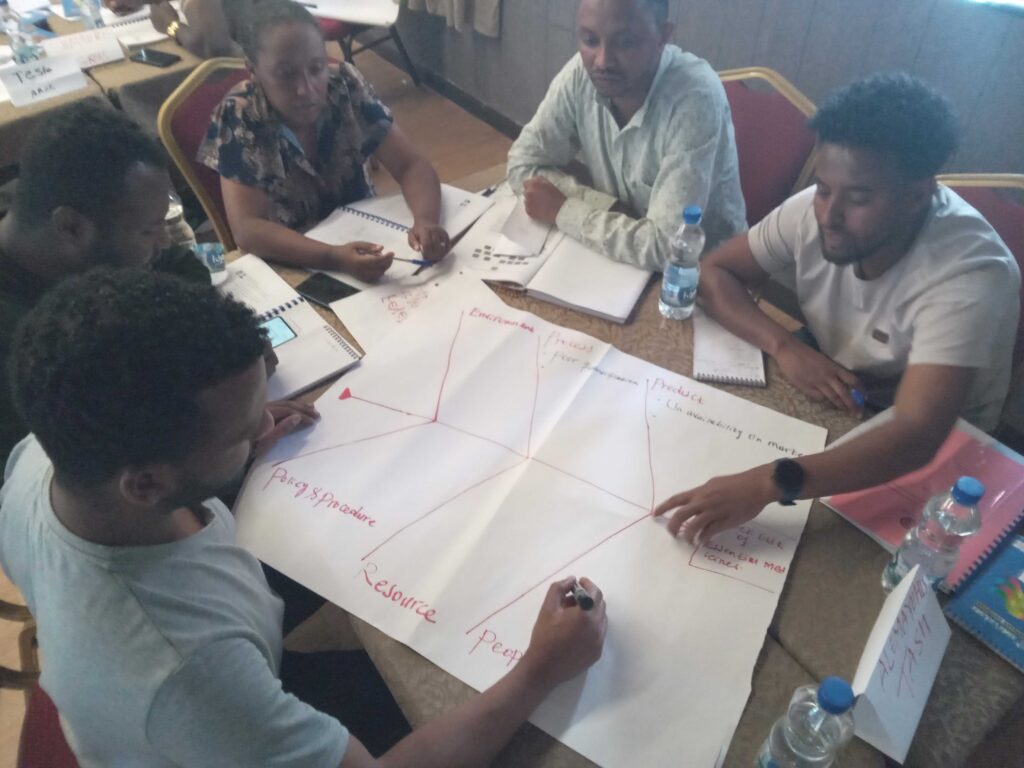
In today’s shifting global landscape, marked by a steady decline in foreign aid and donor funding, what once felt distant has arrived much sooner than expected. This new reality presents a critical mandate for low and middle-income countries (LMICs), which need to strategically pivot to build domestic capabilities, reduce dependency on external financing, and design health interventions that can endure long after projects end.
In this new environment, sustainability needs to be embedded in the intervention design as a foundation. New interventions should be intentionally designed for scalability, ensuring they are adaptable across various contexts, maximize resource efficiency, and are continually improved through shared expertise.
Designing from the Inside Out
This thinking sits at the core of inSupply Health’s approach and work. inSupply co-creates solutions within health systems, leveraging proven tools and processes tested in one geography and thoughtfully contextualizing them for another. This approach is grounded in the principle that solutions must be locally tailored and originate from local potential.
In Ethiopia, this philosophy shaped the Reproductive, Maternal, Neonatal, Child Health (RMNCH) data-use project, implemented as a one-year sub-activity under the Workforce Development in Public Health Supply Chains project.
From the outset, inSupply actively engaged the Ministry of Health through co-creation, co-design, and joint implementation. The goal was to strengthen data use practices that directly improve RMNCH supply chain management.
Adapting What Works, Strengthening What Matters
To achieve this, inSupply drew on its IMPACTT approach and successful implementation experience in Kenya and Tanzania to redesign Ethiopia’s Pharmacy Performance Monitoring Team (PMT). The redesign process was deliberately participatory, engaging key government stakeholders alongside implementing partners active in the supply chain landscape. This resulted in a shared solution shaped by those who would ultimately own and sustain it.
From Pilot Success to Government Ownership
The results from the two-region pilot sparked an “early interest” from the Ministry, where, less than a year into the pilot, the Ministry of Health held a national orientation for all regional health bureaus.
The Ministry led the development of a Pharmacy PMT training course and integrated it into the existing Pharmaceutical and Medical Device Monitoring and Evaluation training program. This strategic integration marked a critical shift from a standalone pilot to a nationally embedded system.
What makes the Pharmacy PMT journey particularly compelling is government ownership and the strong buy-in from implementing partners. Their willingness and enthusiasm to support rollout and scale have further strengthened confidence in the approach’s long-term sustainability.
Embedding Data Use
Previously, monitoring and evaluation training focused solely on key performance indicators (KPIs). The newly developed curriculum now embeds data use as a core competency, incorporating:
- Data quality assessment tools
- Problem identification and prioritization
- Root cause analysis
- Action planning
- Performance recognition and learning
This shift signifies that the system will use data to report statistics, improve performance, and support informed decision-making.
A Milestone for Sustainability and Scale
The journey reached a significant milestone when the Ministry of Health’s Human Resource Development Lead Executive Office, the body responsible for workforce capacity building and training standardization, approved the Pharmacy PMT training course with Continuing Professional Development (CPD) accreditation.
Today, the Pharmacy PMT is a standardized, CPD-accredited national training course that strengthens the use of supply chain data and performance at scale. What began as a small, time-bound pilot has evolved into a nationally integrated approach, rooted in local ownership, aligned with system priorities, and built for sustainability.
In an era where countries must do more with less, this journey offers a powerful lesson: when solutions are designed from within, co-owned by the government, and embedded into national systems, small pilots can indeed grow into lasting national impact.