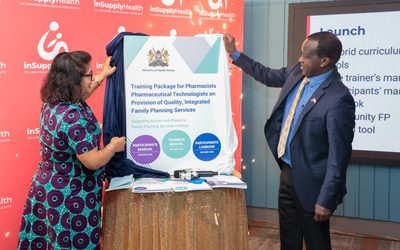

A year ago, inSupply Health convened the Ministry of Health and more than 18 organizations working across family planning, community engagement, private-sector service delivery, youth engagement, and health systems to explore a critical question:
If pharmacies can provide family planning services, what will it take for people to know about those services, trust them, and choose to use them?
The convening brought together diverse perspectives and experiences, leading to the development of the Family Planning in Pharmacy Demand Generation Roadmap, a shared framework that connects awareness creation, community engagement, provider capacity, digital channels, client experience, retention, advocacy, and youth engagement.
But developing the roadmap was never the end goal.
The real test was what happened when these ideas met the realities of implementation.
One year on, our work with partners has given us an opportunity to see what has resonated, what has evolved and where we still have questions. More importantly, it has reinforced a fundamental lesson:
Demand generation is not a single activity. It is the experience a person has from the moment they become aware of a service to the point where they access it, trust it and decide whether to return.
From awareness to a connected journey
It is easy to think of demand generation as creating awareness, telling people that family planning services are available.
But awareness alone does not guarantee access.
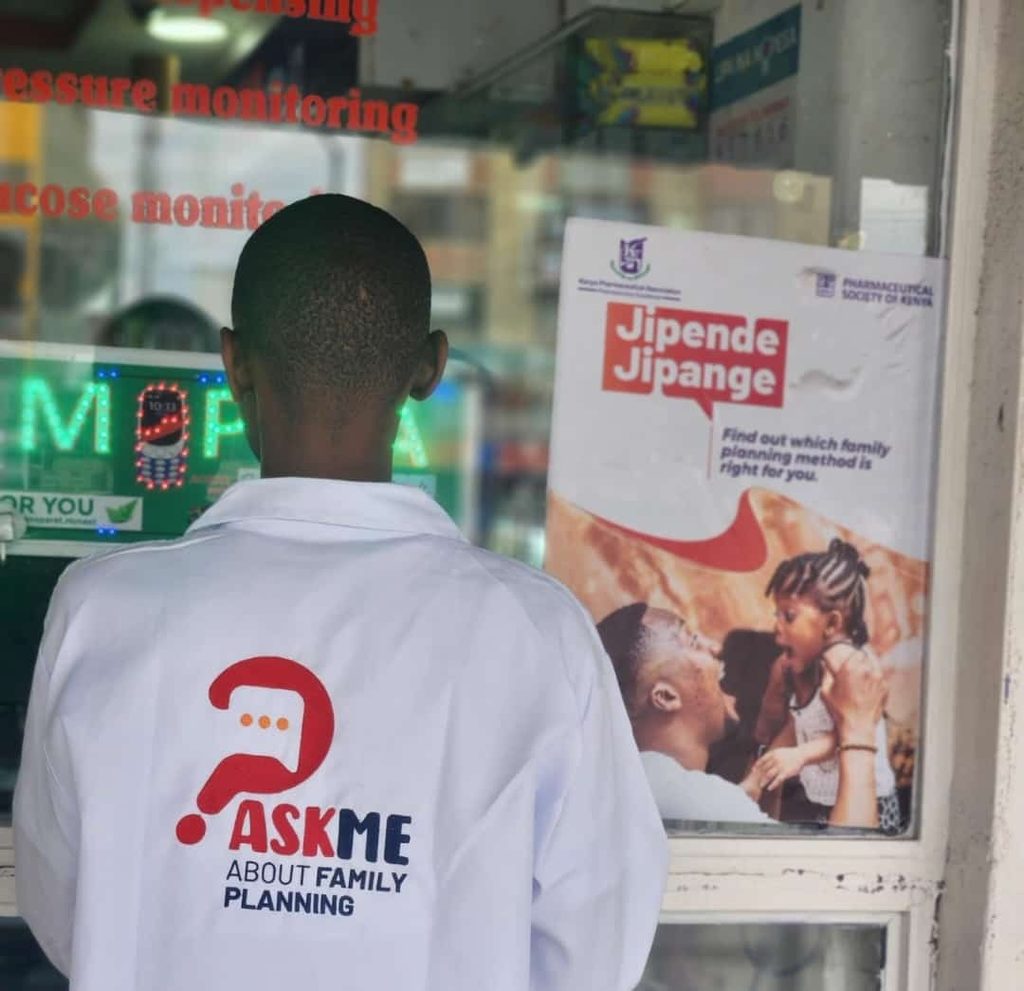
A person may hear about family planning from a community mobiliser, encounter information on WhatsApp or see the Jipende Jipange signal at a pharmacy. The next questions are more practical: Where do they go? Is the service available? Will they find a trained provider? Can they ask questions privately? What happens after they receive the service?
Over the past year, implementation has made us more conscious of what happens beyond the initial awareness or referral activity. Reaching someone is only one part of the journey; understanding whether they reached the service point, what their experience was, and whether they received appropriate follow-up is equally important.
This has shifted how we think about demand generation.
The objective is not simply to generate interest. It is to create a connected pathway from awareness to access and, ultimately, continued engagement.
Connecting communities to trusted service points
One of the areas we have continued to explore is the connection between community-based demand creation and private-sector service delivery.
Community Resource Persons can play an important role in creating awareness, addressing misconceptions and helping clients navigate available services. But the strength of that approach depends on what happens after the referral.
Implementation has highlighted the importance of clear roles, referral mechanisms and stronger links between community actors and accredited private pharmacies. Where community mobilisers understand where they are referring clients, what services are available and how follow-up can be supported, the referral becomes more than simply directing someone to a facility.
It becomes part of a connected client journey.
This is particularly important in contexts where people may face misinformation, stigma or uncertainty about family planning. A trusted community-level conversation can help someone take the first step, while a quality service experience can determine what happens next.
The lesson for us has been clear: the closer we can connect community engagement to a real, trusted service point, the more meaningful demand generation becomes.
Trust is part of demand generation
A client does not make a decision based only on whether a service is physically available.
They also consider whether the environment feels safe, confidential and welcoming.
This is particularly important for family planning, where misconceptions, stigma, provider bias and concerns about privacy can influence whether someone seeks a service.
The Jipende Jipange signal was designed to help make quality more visible by identifying participating service points. But implementation has reinforced that branding is only one part of building trust.
As one private-sector pharmacy provider shared:
“The Jipende Jipange branding and talking walls solved our biggest challenge on the demand side: trust. When clients see the signal outside and the visual guides inside, they know immediately that they are in a safe, non-judgmental environment.”
The lesson for us has been clear:
A visible promise has to be matched by a consistent experience.
A sign outside the pharmacy may encourage someone to walk in. What happens inside determines whether that trust is reinforced.
The pharmacy experience is part of demand generation
This has also changed how we think about the role of the pharmacy.
The pharmacy is not simply the endpoint of a demand-generation campaign. It is itself part of the demand-generation environment.
The provider interaction, the privacy of the consultation, the availability of information, convenience, and the overall client experience can all influence whether someone feels comfortable seeking a service and whether they return.
This is why provider capacity building needs to encompass more than clinical knowledge.
Training in communication, confidentiality, provider bias, values clarification, and non-judgmental care can help providers respond to the diverse needs and circumstances of their clients.
For young people in particular, the experience matters.
A pharmacy may be conveniently located, but if a young client does not feel respected or able to ask questions, proximity alone will not create sustained demand.
This has reinforced our belief that client experience is not separate from demand generation; it is one of its most important components.
Young people are helping us rethink what convenience means
Working with partners has also highlighted the importance of understanding what convenience means from a young person’s perspective.
It may mean a location close to home or work. It may mean flexible opening hours. It may mean privacy. It may mean being able to find information digitally before deciding whether to visit.
It may also mean being able to engage with a provider without feeling judged.
These insights have strengthened the roadmap’s emphasis on youth-responsive approaches and reinforced the importance of creating opportunities for young people to shape how services are communicated and delivered.
The lesson is not that there is one “youth approach.”
Rather, young people need to be considered as participants in designing the demand-generation journey, rather than simply as recipients of messages.
Digital engagement works when it connects people to action
Over the past year, we have also seen the growing role of digital channels in helping pharmacies become more visible and accessible.
Tools and approaches such as WhatsApp Business, Google Business Profiles and targeted digital content can help clients discover services, ask questions and navigate to a service point.
But our experience has reinforced an important distinction:
Digital visibility is not the same as digital engagement. The most useful question is not simply, “Are we online?”It is: “What can someone do after they find us online?”
Can they identify where to access the service? Can they ask a question? Can they receive reliable information? Can they take the next step?
This has encouraged us to think about digital channels as part of the service journey rather than as a standalone communications activity.
Sustainability has to be part of the demand conversation
Another important lesson has come from working more closely with private pharmacies.
For public-health programs, the focus naturally centers on health outcomes and access.
For a private provider, sustainability is also part of the equation.
This means demand-generation approaches need to consider the realities of running a private pharmacy — including customer engagement, service quality, visibility, and the ability to build lasting relationships with clients.
Our experience has reinforced the importance of positioning family planning within a broader pharmacy service proposition, rather than treating it as a standalone program activity.
This has challenged us to think about the private sector not simply as another channel for delivering services, but as a partner with its own incentives, capabilities, and sustainability considerations.
The question becomes:
How do we create a model that works for the client, the provider, and the health system?
That question remains central to the work ahead.
A shared framework can help move from fragmented activities to a connected model
Perhaps one of the most significant outcomes of the roadmap has been the ability to bring different parts of the ecosystem into the same conversation.
Community mobilization, provider capacity, digital engagement, client experience, retention, and advocacy are often discussed as separate areas of work.
The roadmap helped bring them together.
As one implementing partner reflected:
“The roadmap transformed how we coordinate with county health teams and private providers. It gave us a clear, step-by-step framework to train pharmacy technologists, equip CHPs, and track referrals without reinventing the wheel each time.”
That is important because the value of a framework lies not simply in documenting what should happen. Its value is in whether it helps people work differently.
For us, the roadmap has increasingly become a reference point for connecting activities that might otherwise remain fragmented, while providing partners with a common language for discussing demand generation across the community, private-sector, and health-system levels.
One year on: what has changed in our thinking?
A year on, some of our thinking has become clearer. We have moved from asking, “How do we create demand for family planning through pharmacies?” to asking: How do we continue to create a connected experience that makes pharmacy-based family planning easy to find, easy to access, trusted, and worth returning to? That shift has important implications. It means measuring more than reach. It means paying attention to what happens after a referral. It means considering provider behavior and the client experience alongside communication. It means designing digital engagement around action. It means listening to young people. And it means recognizing the sustainability needs of private providers.
The past year has also reminded us that there is no single formula for demand generation. Different communities have different needs. Counties have different systems. Pharmacies have different capacities. Young people are not a homogeneous group. And what works in one setting may need to be adapted in another.
There are still questions we need to answer. What approaches are most effective at converting awareness into service uptake? What drives continued use? How can referral and follow-up systems be strengthened? What makes pharmacy-based models sustainable? And how do we measure the client experience alongside program reach?
These are not simply gaps in the roadmap. They are the next stage of learning.
A year ago, inSupply Health brought together the Ministry of Health and partners to develop a shared approach to strengthening demand for family planning through pharmacies. Today, we see the roadmap less as a finished blueprint and more as a living resource, one that should continue to evolve as partners test, adapt, and learn from implementation. The most important lesson may be that demand generation is not something that happens around the service. It happens throughout the entire experience.
From the first conversation in a community, to the referral, the pharmacy door, the provider interaction, the digital follow-up, and the decision to return.
That is the opportunity ahead: not simply to move the family planning counter closer to communities, but to build a journey that people can find, trust, use and choose again.
One year on, that is what we are continuing to learn together!