By Village Reach, inSupply Health, and the Department of Health Products and Technologies (MOH)
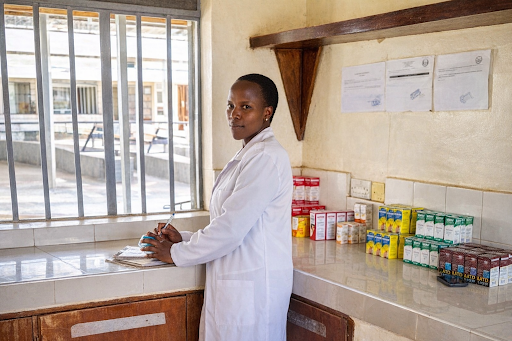
At Lokori Sub-County Hospital in Turkana County, Kenya, Joyce Chebet watched a mother walk in one morning needing an Intrauterine Contraceptive Device (IUCD), a family-planning device. The team thought they had none, yet the woman could not afford to buy one privately. However, despite her doubts, Joyce checked the medicine store again anyway and found a single IUCD kit tucked away. With careful preparation, Joyce helped the mother access the IUCD service. “She was so happy,” Joyce remembers. “She kept saying, ‘God bless you. While the client was “lucky”, it left Joyce stocked out, and subsequent women coming in for IUCDs would not be as lucky, until the next restock.
In Turkana County, the distance between health facilities and communities is long, and transport is unpredictable. Health supplies can be slow to move, and when a child falls sick, every hour of delay hurts. Joyce’s role is to ensure the right medicines, medical supplies, and diagnostics are available when they are needed most.
What is Quantification?
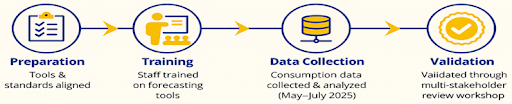
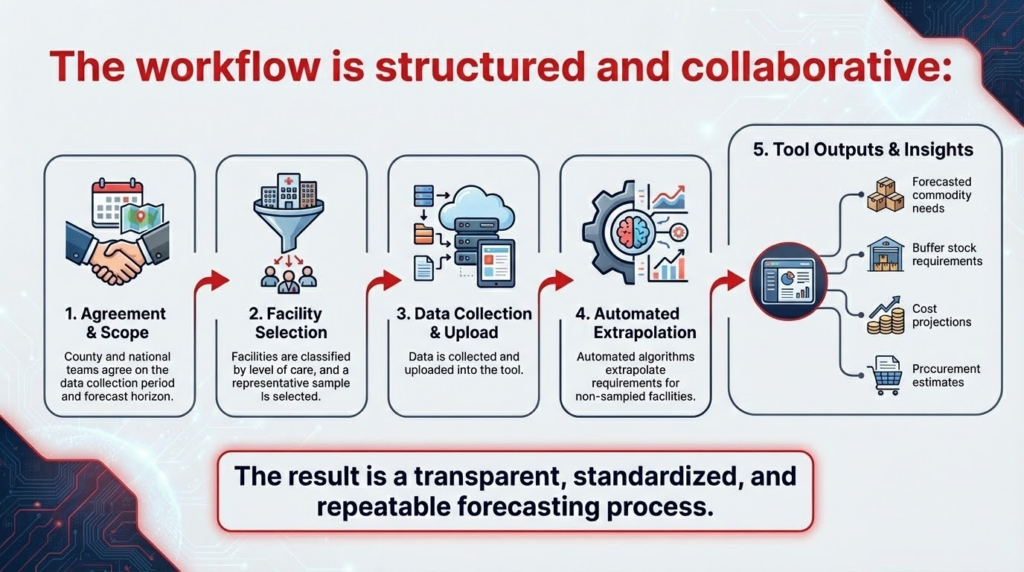
Quantification is the annual process that health facilities, Counties, and National programmes use to estimate how much of each health product they will need (forecasting) and the associated costs (for procurement and other logistics, such as distribution), based on key data. It brings together local, national stakeholders, and development/implementing partners to guide purchasing decisions. The process begins with agreement on the methods and tools for data collection and analysis, followed by training staff in their use. Data on health product use over the past year are collected, after which projections of health product needs for the coming year are calculated and agreed upon by the government and its partners.
Importance of quantification
The process of quantification aims to ensure the right health products are in the right place at the right time. For Joyce, it means estimating how many health products her facility will need, reducing shortages/stock-outs, and preventing expiries. “It helps us know what is needed,” she says, “so we don’t run out of stock or waste what we have.”
For years, quantification work was slower and more fragmented than it needed to be. Across Kenya, forecasting often relied on manual, Excel-based processes, repeated data transfers, and multiple workshops. In the past, health facilities did not collect data digitally, making the process of collecting and calculating estimates for health product needs laborious, expensive, and time-consuming. Many health facilities were not fully digitized, so data collection, aggregation, and extrapolation had to be done manually.
Mark Osiemo, supply chain manager at inSupply Health, notes: “The work was labour-intensive and highly prone to errors, with broken formulas and long turnaround times that could force teams to restart large parts of the process.”
New and Improved Quantification Process
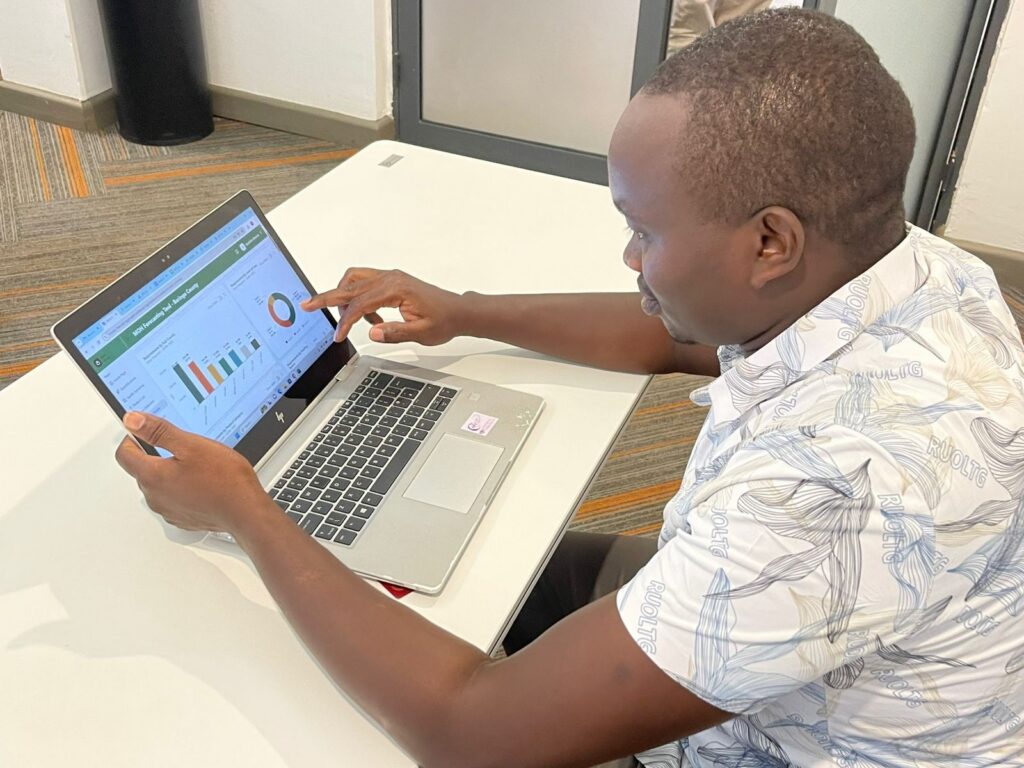
That changed in 2025, when VillageReach and inSupply Health began partnering with County governments to conduct quantification exercises for HPT using a simplified tool developed by inSupply Health and co-created with the Kenya Ministry of Health’s Directorate of Health Products and Technologies (DHPT).
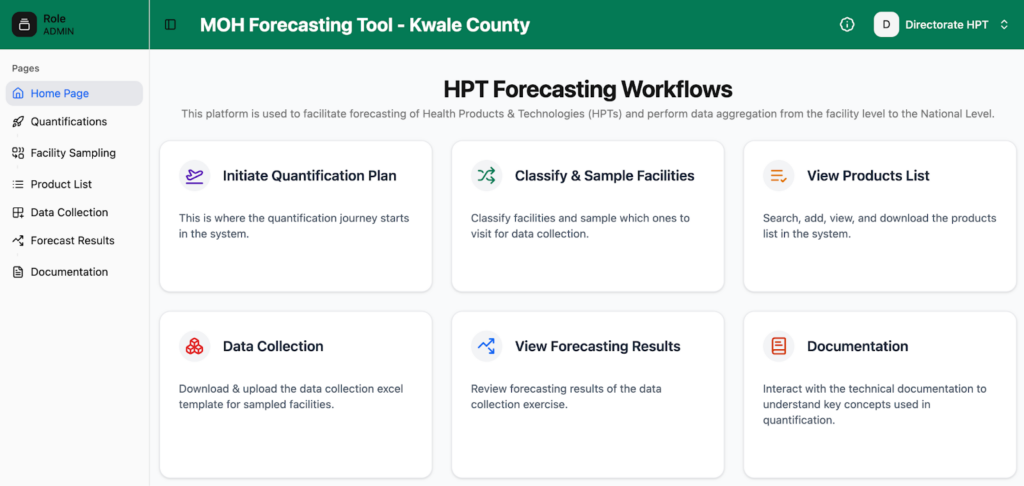
MOH Forecasting Tool: A web-based platform that simplifies Health Product & Technologies Quantification
George Mwangi, Data Analyst at inSupply Health, explains: “The real challenge wasn’t collecting data; it was what came next. We needed to use data from a few facilities to forecast what was happening in others, without making mistakes or introducing bias, and then combine all the information into a bigger picture. To ensure these forecasts guide what is ordered and procured, inSupply also developed the Strategic Resource Management Tool (SMArT), which ensures resources are used efficiently.
Before the tool, Joyce and her team leaned heavily on morbidity patterns and on what was moving fastest. For instance, if paracetamol were used more frequently, they would order more of it, while less common health products could easily be overlooked.
But after quantification, they took stock of all health products, identified idle or slow-moving stocks, and redistributed items, moving short‑shelf‑life products to facilities where they could be used. This reduced wastages and maximised existing resources.”
The MoH quantification tool helps make that work easier within a short period of time. Once the stock on hand, consumption data, and days out of stock are entered, the average monthly consumption is automatically calculated, and forecasts are generated. This frees quantification teams from spending time wrestling with spreadsheets, allowing them to focus on the decisions that matter.
Dr. Jamlick Karumbi, M&E, DHPT, notes, “The goal is to strengthen government systems, standardize quantification, and support accountable decision-making. Automation allows teams to focus on validating assumptions and interpreting results rather than manipulating spreadsheets.”
Joyce explains that the county management team helps coordinate redistribution, and WhatsApp groups are used to share information about overstock and shortages. If one health facility has what another needs, the stock can be moved. Partners also help with logistics, such as transport, where possible. This kind of coordination matters in a county where distances are long, and vehicles are limited. To cushion the system, the team maintains a buffer stock of about 2 months.
This buffer stock helps when rain, floods, or supply interruptions make roads impassable. It is one of the ways the system protects patients before they feel the gap. Joyce described it as a bridge to address shortages and slow lead times.
Joyce says that children suffer most when HPT runs out of stock. Adults can sometimes wait or explain their symptoms; children arrive when things are already serious. In that moment, HPT availability determines whether they receive treatment or face a dangerous delay.
Quantification: creating evidence for action
The MoH Quantification tool, brought to life in Counties through VillageReach’s hands-on support, was designed to strengthen and standardize quantification at the health facility, County, and National levels. It was first piloted in Trans Nzoia County before being redesigned based on user feedback for wider use. It now supports the Quantification process, budgeting, and procurement planning, all designed to be owned and run by government teams.
In Turkana County, this partnership enabled the County to quantify community-level HPT for the very first time, giving visibility into what community health promoters (CHPs) actually need and use. Counties can now participate in budget meetings with credible numbers. In Isiolo, for example, the tool’s outputs helped secure a 108 % increase in budget allocation for FY2024/25 compared with the previous year.
The quantification exercise also revealed that only a modest investment is required to purchase enough health products to ensure CHPs are fully stocked for the year. It costs approximately USD 212 per community health worker per year to keep essential HPT available at the community level.
In a setting like Turkana, that small investment can mean the difference between a child being treated early at home or arriving at a health facility already in critical condition.
The availability of quality data, user-friendly quantification tools, and stakeholders dedicated to leveraging data for decision-making can have a dramatic impact on the availability of health products. In the end, when HPTs are available when needed and in the right quantities, a child is treated before it is too late. A mother does not have to walk away empty-handed. A health facility wastes less medicine. A CHP heads back to the village with HPT, ready to provide services.
And a pharmaceutical technologist like Joyce knows she is helping shape a system that actually works for the people who rely on it. That is the real story, not the spreadsheet, not the tool, but counties and a nation learning to plan better for the families/clients they serve.