Building Sustainable Digital Systems for Better Health Decisions
Across many health systems, digital tools are transforming how governments forecast health commodity needs, allocate resources, plan budgets, and make critical supply chain decisions. Yet while significant investments are often made in developing innovative digital solutions, a critical question remains: what happens after implementation?
Too often, digital tools are developed through donor-funded projects and hosted on external platforms that remain disconnected from government systems. While these solutions may deliver value during implementation, their long-term sustainability can become uncertain when continued access depends on project timelines, external hosting environments, or ongoing partner support.
Recognizing this challenge, Kenya’s Ministry of Health Directorate of Health Products and Technologies (DHPT), the Ministry of Information, Communications, and the Digital Economy, inSupply Health, and development partners have been working together to strengthen not only digital innovation, but also the long-term ownership and sustainability of digital health investments.
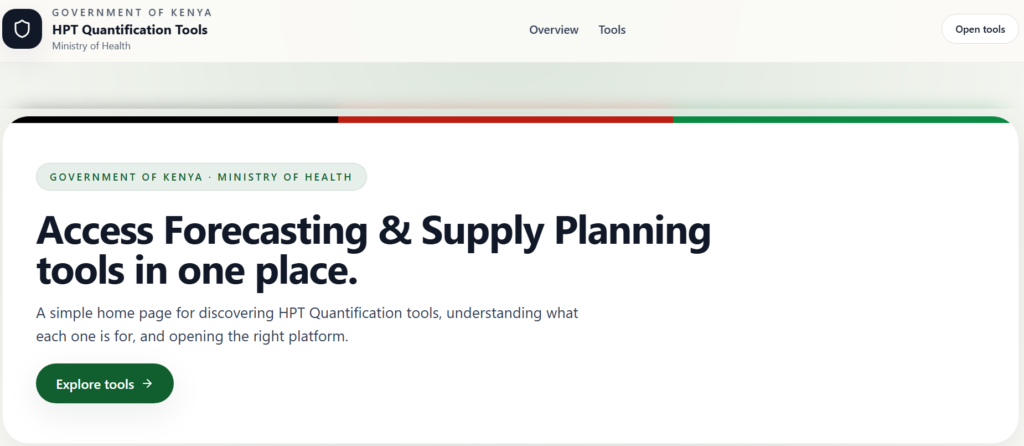
inSupply, with support from the Patrick J. McGovern Foundation and the Gates Foundation, recently reached a major milestone: the successful migration of four (4) digital health planning and decision-support tools to the Ministry of Health infrastructure under the government domain, hpttools.health.go.ke, with two more in transition.
This transition represents a significant step toward country ownership, ensuring that critical digital systems remain accessible, sustainable, and aligned with national priorities long after their initial development.
Supporting Better Decisions Through Data
Health product planning requires timely, accurate, and accessible data. Yet fragmented information systems, manual planning processes, and limited visibility across different levels of the health system can make forecasting, budgeting, and resource allocation challenging.
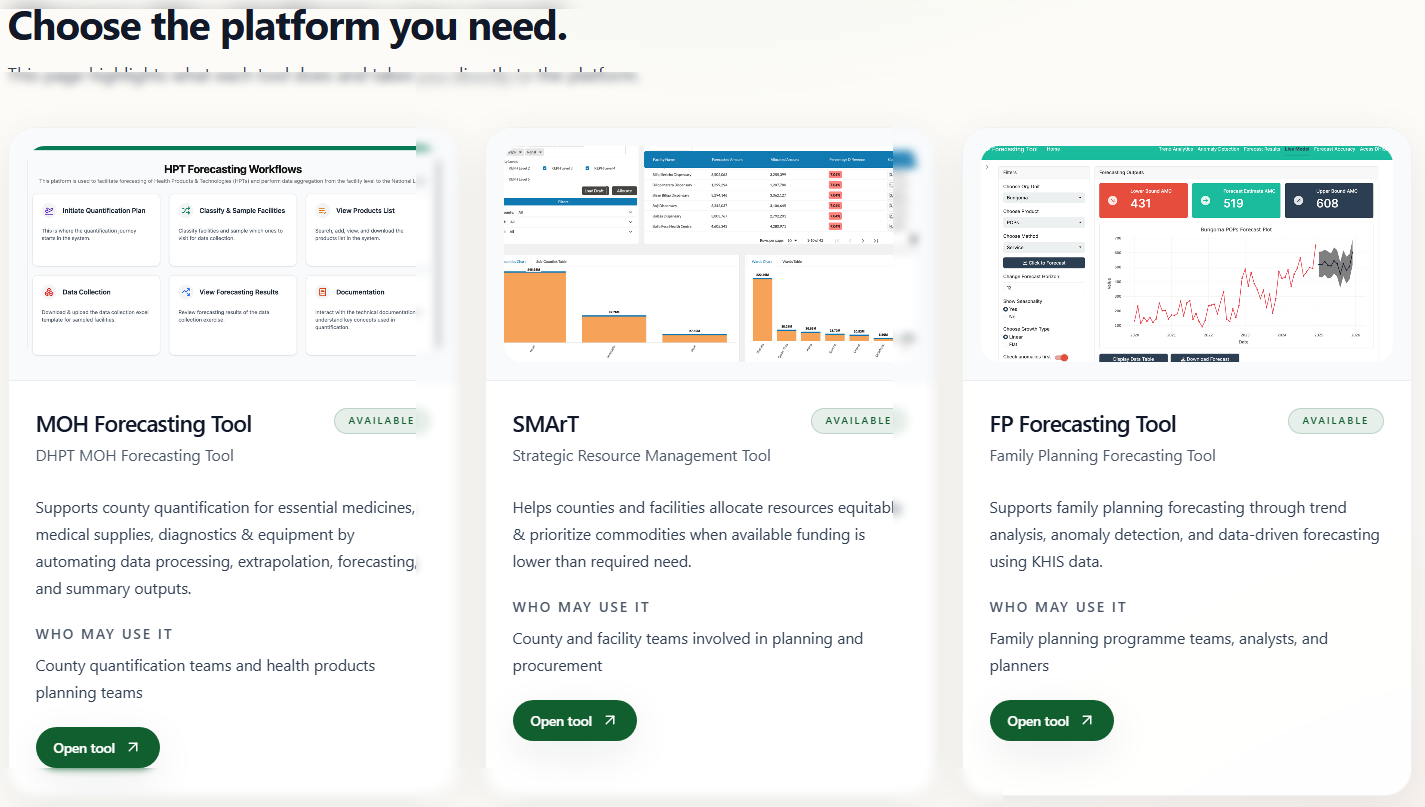
To address these gaps, inSupply Health worked closely with the Department of Health Products and Technologies (DHPT) and other stakeholders to develop a suite of digital decision-support tools that transform complex health data into actionable insights for national and county decision-makers:
County Health Products and Technologies Forecasting Tool
Before the tool, the Kenya Health Information System (KHIS) had data for only 85 tracer commodities, while counties manage 2,500+ products, making annual county quantification difficult for budgeting and procurement. It automates data collection, cleaning, standardization, classification, extrapolation, and aggregation from sampled facilities to produce county-wide forecasts. Reported results include reducing preparation time from months to weeks, reducing data cleaning time from weeks to under 30 minutes, rolling out in 11 counties (Nairobi, Kakamega, Isiolo, Nakuru, Trans Nzoia, Laikipia, Narok, Kwale, Baringo, Turkana, Nyamira), and planning to scale up to all 47 counties. Use case example: Nairobi City County Quantification Technical Report for Health Products and Technologies – FY 2024/25 to FY 2026/27
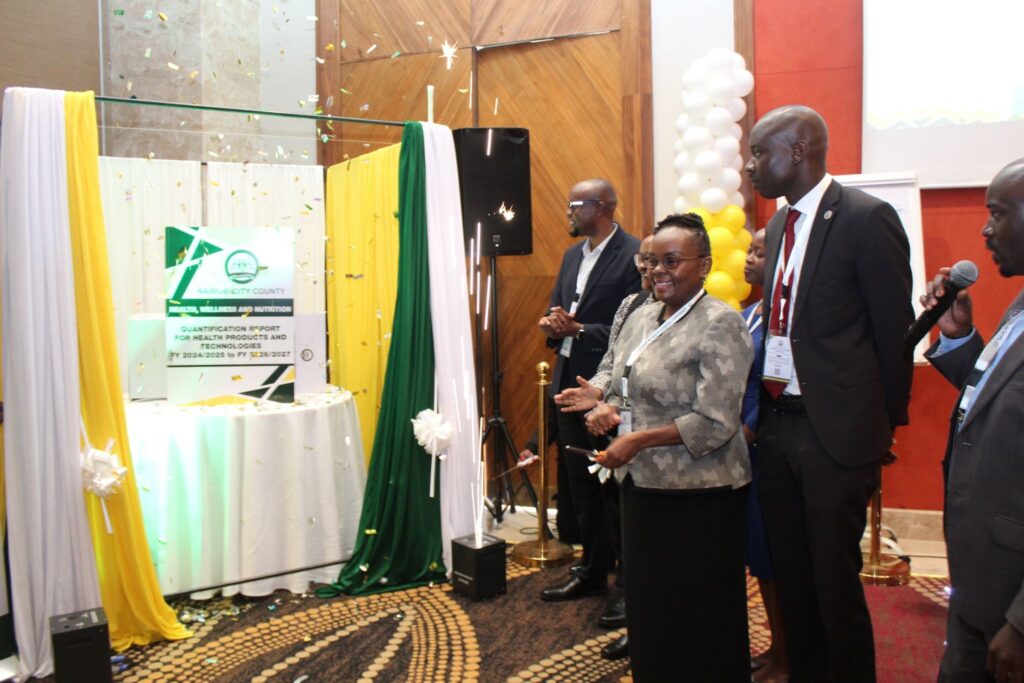
Launch of the Nairobi City County Quantification Report at the County’s First Health Conference, 2024.
Family Planning Forecasting Tool
Replacing manual processes that relied on limited historical data, this tool automates the extraction and cleaning of 60+ months of data from over 10,000 facilities. Applying advanced ML models (XGBoost, Prophet, Random Forest) improves forecast accuracy and addresses gaps such as non-reporting. This data-driven approach has increased user trust: for the FY 2025/26 quantification, 7 of 13 FP products utilized these ML-generated forecasts to support procurement. Use case example: Family Planning Commodities Forecasting and Supply Planning Technical Report, FY2025/26 to FY2027/28
Maternal, Newborn and Child Health (MNCH) Forecasting Tool
The MNCH tool addresses the same core quantification bottleneck: manual cleaning, limited historical data, aggregated review, weak treatment of outliers, missing values, and non-reporting. It uses 60+ months of historical data from 10,000+ facilities, cleans data by facility and month, detects outliers, fills missing values, adjusts for non-reporting, and allows stakeholders to compare pre- and post-cleaning outputs before approving forecast inputs. From a supply chain perspective, this improved forecast quality, preserved contextual differences across geographies, and shifted workshop time from manual data work to validation and decision-making. Use case example: Technical Report for Quantification of Priority Maternal and Newborn Health Products and Technologies – FY 2025/26 – 2027/28
Strategic Resource Management Tool ( SRMT)
SRMT addresses the gap between forecasted commodity needs and limited available budgets, which creates stockout risk, reduced commodity availability, and inefficient procurement choices. It uses forecast outputs as the foundation for structured allocation and prioritization, helping county, sub-county, and facility users prioritize commodities using need, stock on hand, budget constraints, VEN/ABC classifications, workload, and population needs. Reported results include improved transparency and data-informed purchasing decisions, implementation, and facility-user training across five counties (Nairobi, Kakamega, Isiolo, Nakuru, Trans Nzoia), as well as broader evidence that SMArT supported increased HPT procurement budgeting by +13% to +108%. Use case example: The SMART way forward: A Data Driven Tool and Approach for Strategic Resource Allocation and Commodity Prioritization in Kenya’s Devolved Health System.
Further to these tools are the indicator tracking tool and the MOH 647 tracer dashboards, both of which are currently under transition
This digital dashboard transforms routine KHIS supply chain data into actionable insights. Automating the extraction and visualization of key metrics, such as reporting rates, stock status, and data quality, it overcomes the challenge of underutilized logistics data. With real-time performance dashboards, the ITT strengthens routine monitoring, enhances accountability, and enables faster, evidence-based decisions to improve commodity availability and supply chain performance.
This interactive tool transforms data reported through the MOH 647 tracer form into actionable insights, addressing the limited use of routine information for inventory management. By consolidating facility-level data into clear visualizations of reporting performance, stock levels, and consumption trends, the dashboard enhances data completeness and timeliness. This transparency empowers national and county teams to make evidence-based decisions on resupply, redistribution, and commodity prioritization.
Collectively, these tools power critical supply chain functions, including forecasting, strategic resource management, budgeting, and performance monitoring. They are already proving their value in national and county-level planning by enabling stakeholders to accurately forecast commodity needs, prioritize funding, and make data-backed supply chain decisions. Crucially, the objective was never just to build standalone applications; it was to embed practical decision-support systems directly into Ministry of Health processes, ensuring they serve users effectively for the long term.
From Development to Ownership
Developing effective digital tools is only the first step; ensuring their long-term accessibility is equally critical. Sustainability often falters when systems remain reliant on external hosting, creating barriers to adoption and scalability. To mitigate this risk, the Ministry of Health, the Ministry of Information, Communications, and the Digital Economy, and their partners collaborated to migrate these tools to government infrastructure. Today, all six tools are centralized under a single MoH domain, securing reliable access and marking a pivotal shift from project-dependent solutions to sustainable, nationally owned digital infrastructure.
Establishing Country Ownership
This migration is more than a technical milestone; it reflects a commitment to strengthening Kenya’s digital health ecosystem through government-led, institutional ownership. When governments own their decision-support systems, they are better positioned to maintain, adapt, and scale them as national needs evolve. Furthermore, centralized access provides stakeholders with greater visibility and continuity, while creating a stable foundation for future enhancements and integration with national systems. For partners, this underscores a vital lesson: sustainable digital transformation requires investing not only in innovation but also in governance, interoperability, and long-term stewardship.
Lessons Learnt
Design for sustainability: Plan for hosting, maintenance, and governance from the very beginning, rather than treating them as an afterthought.
Collaborate across sectors: Successful migration depends on deep coordination between government institutions, technical teams, and partners working toward a shared vision.
Centralize to simplify: Housing multiple tools under a unified platform removes access barriers and strengthens the broader digital ecosystem.
Embed to ensure adoption: Digital solutions are more likely to thrive when integrated into existing government processes rather than operating as standalone project outputs.
What Next?
As the global conversation around digital health shifts from development alone to long-term sustainability, Kenya’s experience offers a clear roadmap. The true measure of a digital tool is not just its initial functionality, but its ability to remain accessible, trusted, and useful over time. By embedding these solutions within the Ministry of Health infrastructure, Kenya is building a resilient foundation, ensuring the capacity, ownership, and infrastructure needed to sustain these investments for years to come.