Tanzania | Tanga City Council | 2024–2025
Tanzania | Tanga City Council | 2024–2025
Facility-Level IMPACT Teams at Tanga City Hospital
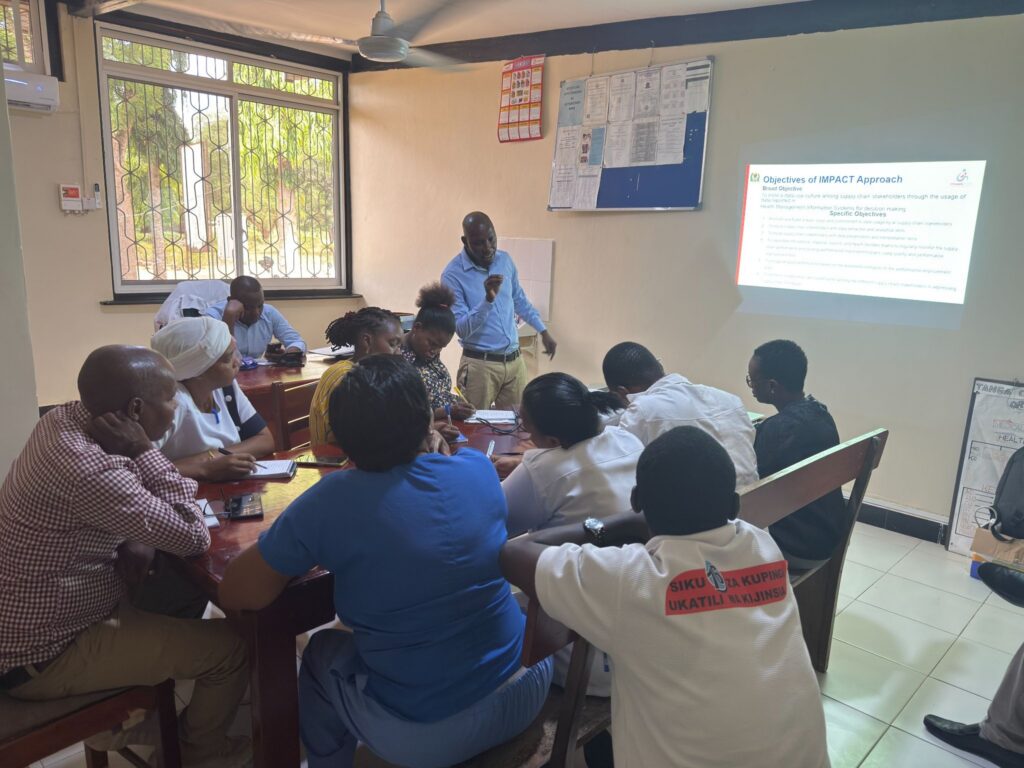
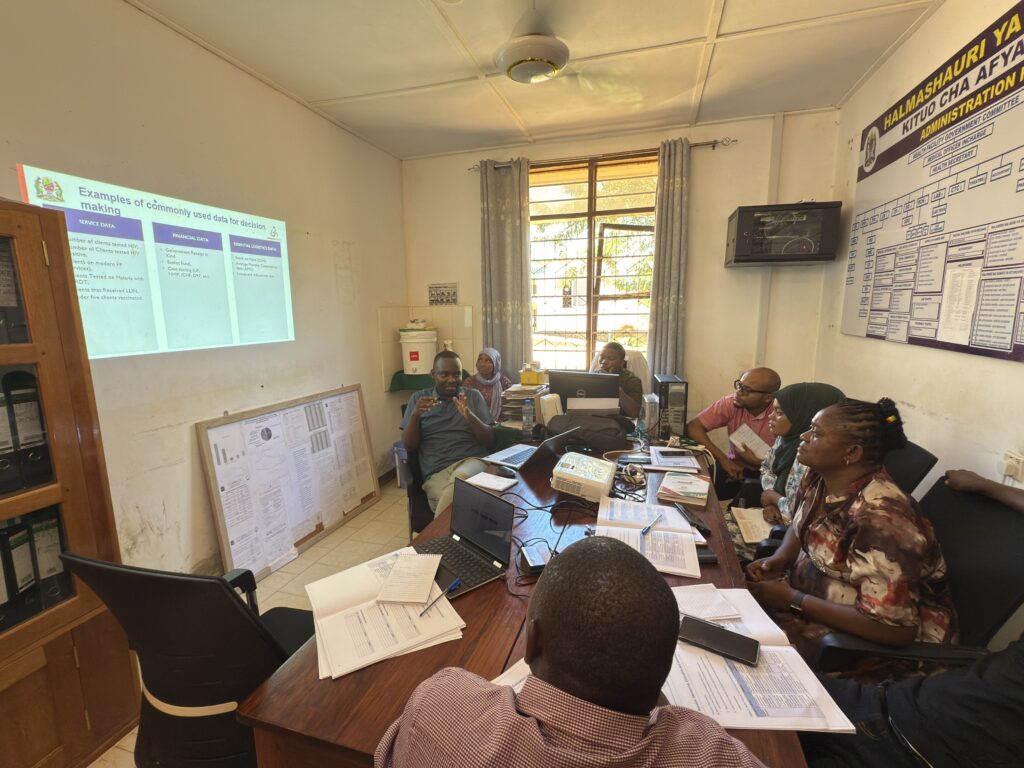
In May 2024, staff at Tanga City Hospital were trained on the IMPACT Teams approach by representatives from the regional and council health management teams, the Ministry of Health, the Prime Minister’s Office, Regional Administration and Local Government, and inSupply Health. During the initial training, the facility’s supply chain performance fell short of national targets. Health commodity availability stood at 85% and laboratory commodity availability at 71%, against a national target of 95%. Stock imbalances were a challenge; 32.5% of health commodities and 19.96% of laboratory commodities were overstocked, reflecting poor ordering and poor data quality.
Monitoring visits following the training revealed that the facility’s first scheduled IMPACT Team meeting did not take place; the majority of the initially trained staff had been reshuffled, including the pharmacist who is the secretary of the IMPACT Teams; stock ledgers had not been consistently updated; and the pharmacy store was disorganized. These findings were escalated to the Tanga City R/CHMT, prompting council-level leadership decisions that proved to be the turning point. By February 2025, new leadership was in place, consecutive IMPACT Team meetings had been held, and supply chain indicators were beginning to improve.
Leadership in Action: Data Use for Decision Making
The transformation at Tanga City Hospital was not the result of additional training, new tools, or external technical assistance. It was the result of three deliberate, key decisions made by the District Medical Officer and the Tanga City Council in direct response to what the IMPACT monitoring activities revealed. These decisions are worth examining individually, both for what they achieved and for what they demonstrate about the relationship between monitoring evidence and leadership in action.
Decision 1: Replacing the Medical Officer in Charge
When monitoring evidence showed persistent non-compliance and no improvement in indicators despite training and a full re-orientation, the DMO made a direct intervention; the Medical Officer in Charge of Tanga City Hospital was reshuffled. This was a response to performance data, and it sent a clear institutional signal that accountability for supply chain outcomes was being enforced at the highest level of district management. The DMO’s willingness to act on monitoring data rather than accept ongoing underperformance was instrumental in ensuring effective implementation of the IMPACT approach. The leadership transition and the provision of extra-duty allowances motivated the team to work additional hours to complete required tasks. The impact was visible at the next monitoring visit. Under the new Medical Officer in charge, IMPACT Team meetings began to take place. Staff engagement improved. The facility’s supply chain performance was also gradually improving.
Decision 2: Recruiting a Qualified Pharmacist
The monitoring visits had consistently identified gaps such as unupdated bin cards and stock ledgers, poor eLMIS reporting, among others. This prompted the suggestion that the current hospital pharmacist be reshuffled and replaced with another.
The new pharmacist was oriented to the IMPACT approach over several subsequent IMPACT team meetings, and measurable improvements in supply chain indicators and data quality were observed. The Tanga City Hospital experience clearly demonstrates that human resource capital is key to improving supply chain performance and management.
Decision 3: Hiring of the Kisosora Pharmacist
During routine monitoring visits, Kisosora Dispensary consistently scored 75% or higher on its DQAS. Physical inventory records were updated, eLMIS-reported data was accurate, and the tally was reconciled with bin cards and stock ledgers at the facility. At Kisosora’s first DQA, the facility scored nearly 80% accuracy for consumption data, the highest score among the 10 facilities implementing the IMPACT Approach. Additionally, Kisosora dispensary was the only facility in the Tanga City Council with no outstanding debt to the Medical Stores Department (MSD).
The monitoring team shared these findings with council leadership. When the council investigated further, they discovered that the pharmacist responsible for this level of performance had not been formally employed; they had been volunteering at the dispensary.
The council responded on two fronts. It issued the Kisosora pharmacist a formal employment contract. The council then directed the Kisosora pharmacist to provide technical support to low-performing facilities, including Tanga City Hospital, mentor the newly recruited pharmacist, and help establish the data quality and stock management practices that were in place at Kisosora.

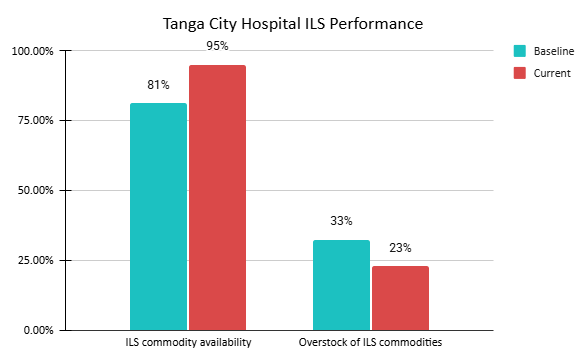
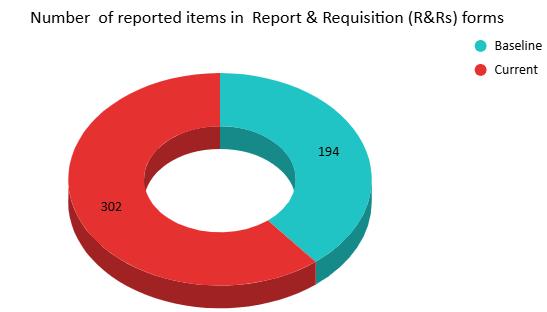
The situation then and now: One year of Data ILS Performance: Availability and Overstock
At baseline, ILS commodity availability at Tanga City Hospital stood at 81.4%, well below the national target of 95%. One year on, the facility has consistently maintained availability at or above 95%, meeting the national target for the first time, a sustained shift in performance directly attributable to council leadership decisions and regular IMPACT Team meetings under the new facility leadership. On overstock, the health commodity overstock appeared to be at 32.5%. However, when the new pharmacist took post and began reporting comprehensively on all commodities managed at the facility, the true overstock figure became visible: 52.96%. The apparent worsening was not a deterioration in performance but rather a correction in eLMIS reporting. The number of reported items went from 194 in the March – April period to 302 items in the September – October period. From 52.96% of overstocked ILS commodities, the overstocks have since declined to 22.92% the period of May-June 2025. This improvement is a direct outcome of better data use, implementation of decisions from IMPACT Team meetings, regular IMPACT Team reviews, and the oversight provided by the council and regional management teams.
Laboratory Performance: Availability and Overstock
The leadership decisions that drove ILS improvements equally shaped laboratory commodity performance. With the new Medical Officer in Charge ensuring consistent IMPACT Team meetings and the newly recruited pharmacist facilitating regular meetings, the laboratory technician, as a core IMPACT Team member, was now participating in regular data reviews that translated into actionable decisions for management of laboratory commodities.
Laboratory commodity availability rose from a baseline of 78.2% reaching 82%, and has shown a clear upward trend, though performance has been less consistent than for ILS commodities. It has, however, not fallen below the baseline, and continued IMPACT Team oversight is expected to drive further improvement. Laboratory overstock has also decreased consistently over the monitoring period, with one notable exception: a temporary spike attributed to a health campaign requiring the facility to procure additional stock to meet increased service demand. Laboratory overstock fell from 19.96% to 9.72% by the reporting period of May – June 2025, which is less than half the baseline figure. Overall, the trend toward lower lab overstocks has remained consistent.
The decline of overstocks of the lab commodities is also attributed to the repair of laboratory equipment, such as chemistry machine. By restoring these machines to operational status, health facilities were able to utilize existing laboratory reagents, which improved service delivery, increased revenue collection, and successfully reduced excess stock.
From Data to Patient Impact
The most tangible measure of these leadership decisions was not found in availability percentages, but in direct patient care. The IMPACT Team at Tanga City Hospital includes both the doctor and the laboratory technician, and it is within these meetings, made possible only after leadership intervened to ensure they took place, that the value of IMPACT Team meetings extended beyond statistics into direct patient care.
During the IMPACT team meeting, a review of no-demand items (medicines available at the facility but unused) was conducted. A doctor noticed that Hydroxyurea was flagged as a no-demand item, yet they had a sickle cell patient in active need of the drug, whom they had directed just days earlier to source it externally. Upon this discovery, the doctor immediately contacted the patient, who was then able to access the medication through the hospital at no cost. A critical intervention, given that a single tablet costs 5,600 Tanzanian shillings at external pharmacies. This would not have happened without a functioning IMPACT Team meeting, and that meeting would not have happened without the leadership decisions that preceded it. Beyond medicines, IMPACT Team reviews also drove an expansion of laboratory services, with the facility increasing the range of tests conducted, including hormonal imbalance testing, further broadening patient access to essential diagnostics.
This expansion reflects what becomes possible when a laboratory professional has a structured, leadership-backed forum to identify and address supply and service gaps.

Conclusion
The experience of Tanga City Council demonstrates that the IMPACT Teams approach is more than a supply chain intervention. When implemented with systematic engagement of sub-national leadership, it becomes a health systems strengthening mechanism that equips leaders to make better decisions about staffing, accountability, and resource allocation and creates the conditions in which those decisions can have a lasting impact.
The Tanga City Hospital case illustrates the importance of strong leadership in improving supply chain outcomes. A facility that failed to implement the approach for over six months was transformed not by additional technical inputs but by three key leadership decisions made possible by the evidence generated by the IMPACT monitoring activities. A medical officer was replaced. A pharmacist was hired. An overlooked talent was discovered, employed, and deployed. Together, these decisions produced the improvements that training alone had not.
For future scale-up of the IMPACT approach at the facility level, the design should recognize that training alone does not produce better results. Real improvement comes from consistent monitoring and strong leadership that uses data to guide decisions. Investments in monitoring, leadership engagement, and accountability are essential. These elements are what turn technical inputs into sustained supply chain improvements.