
Health supply chains are human systems, yet a persistent “knowing-doing gap” constantly undermines system performance. Health workers receive training on new procedures, but often fail to apply them consistently. The BARDI Framework offers a fundamental shift, moving from managing supply chains as human-centered ecosystems to understanding and nurturing them.
In supply chain management, for example, health workers are supposed to update bin cards immediately whenever a commodity is received at the facility (either as a new order from the supplier or redistributed from another facility), leaves the store for the dispensing area, is sent to another facility, or expires. In practice, however, some healthcare workers postpone recording for later, which leads to missing details such as exact quantities or dates. In some cases, bin cards are in short supply and are missing.
Traditional performance improvement approaches often fail because they treat poor performance as a deficit in knowledge or skill, frequently leading to recommendations for more training. This ignores the complex reality on the front lines, where actions are shaped by contextual friction (e.g., during a demanding shift and numerous patients, it takes the healthcare worker longer than usual to update the bin card ), social isolation (e.g., working alone at a remote clinic without a supervisor or peers to offer feedback), and cognitive biases such as status quo bias (e.g., when a health care worker keeps doing things the old way simply because “that’s how we’ve always done it,” even after being trained on a better method).
The Tenets of the BARDI Framework
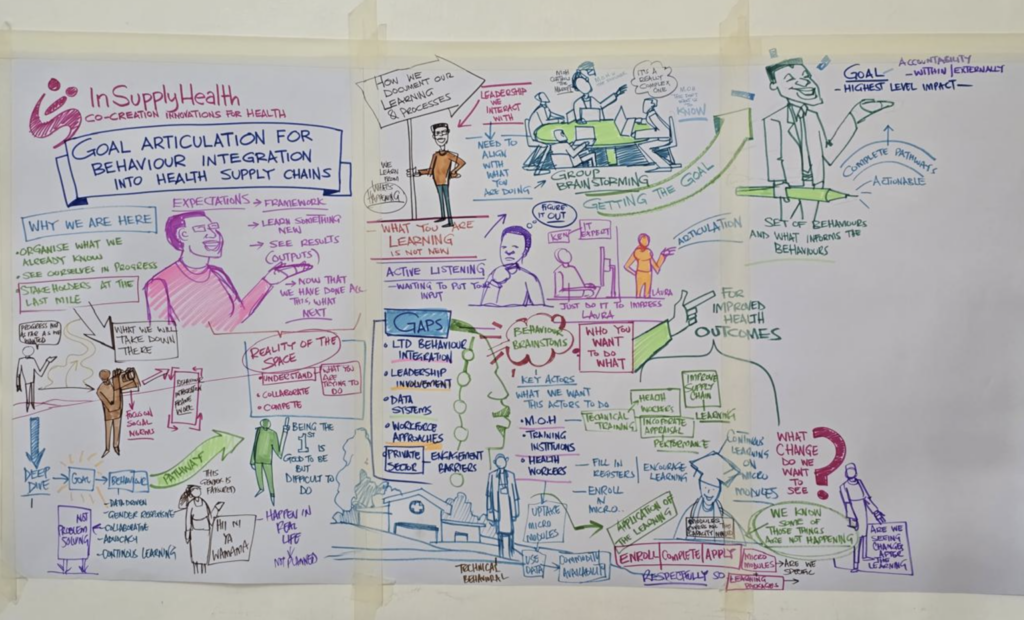
The central insight of the BARDI Framework is that system outcomes cannot improve until the specific human behaviors driving them are addressed. This approach shifts the focus from solving technical puzzles to understanding the human elements that underpin health supply chain performance.
The BARDI Framework is a systematic approach co-created by inSupply health and healthcare workers to strengthen supply chains by addressing both technical and human dimensions. It replaces abstract goals with definitions of behavior as specific, measurable actions performed by defined individuals within a particular context and timeframe.
The framework is built on four core, actionable steps:
Enable: Simplify processes and provide support to reduce friction for initial adoption.
Connect: Build social networks and shared identity to strengthen collective ownership and peer support.
Amplify: Reinforce and scale successful strategies by recognizing progress and making positive behaviors visible and valued.
Embed: Institutionalize new practices into policy and standard operating procedures for long-term sustainability.
Instead of the vague objective to “improve data culture,” the BARDI framework targets specific behavior:
“The data clerk (PERSON) completes the daily consumption form (ACTION) within 30 minutes of the end of their shift at the facility’s reporting desk (CONTEXT).”
The Gap: Health workers often know how to complete inventory forms but may view them as a low-priority bureaucratic task, leading to late or inaccurate reports.
Solution: The BARDI framework reframes data reporting as a professional responsibility linked to patient care. When providers realize that accurate data prevents stockouts and emergency orders, they transition from simply “knowing” the forms to “doing” the reporting accurately and on time.
Impact: Accurate, real-time data allows for precise forecasting, ensuring that a wide variety of modern contraceptives are always in stock
This behavioral approach yields meaningful qualitative outcomes, transforming the supply chain workforce into proactive experts. Rather than attempting to fix abstract issues like “time poverty,” the BARDI framework makes specific actions faster and easier for the individual in their unique context.
Achieving Sustainable Development Goal 3 (SDG 3) requires a motivated and high-performing health workforce. The BARDI framework addresses the “upstream” behaviors that influence health system resilience. By reframing documentation as a source of professional pride and a tool for better patient outcomes, the framework turns a bureaucratic requirement into an essential practice for monitoring SDG progress.
The BARDI framework bridges the “knowing-doing gap” by translating technical knowledge into consistent, high-quality practice. This behavioral shift is a critical driver for achieving FP2030 goals through several key mechanisms:
By prioritizing specific, measurable actions, the BARDI framework is designed to reduce stockouts, improve data accuracy, and increase commodity availability. Ultimately, this approach ensures that health investments achieve their full impact through improved human behavior.
For policymakers and practitioners, the core objective is to institutionalize this behavioral framework into all health supply chain planning and problem-solving. We must move beyond vague aspirations and ask: “How do we enable, connect, amplify, and embed specific, measurable actions?” Let the BARDI framework become the new standard for achieving sustainable health impact.
QUOTE
“Many health supply chain inefficiencies—such as poor data quality, delayed or incomplete reporting, stock imbalances, and weak use of data (e.g., failure to use stock-on-hand data to inform decisions)—are largely driven by inconsistent human behaviors rather than technical gaps.
Using the SBC BARDI framework, data use can be strengthened by defining clear, measurable behaviors such as conducting monthly facility data reviews to validate service and consumption data and identify corrective actions, ensuring that evidence directly informs supply chain decisions and accountability. At the sub-county level, this approach supports health supply chain improvement by institutionalizing routine data reviews and monthly stock counts, enabling facilities to take ownership of their data and promoting consistent practices such as timely reporting, validation, and stock reconciliation, ultimately improving data accuracy, visibility, and commodity security.” Dr. Beatrice Kamau – Sub-County Pharmacist, Nairobi